
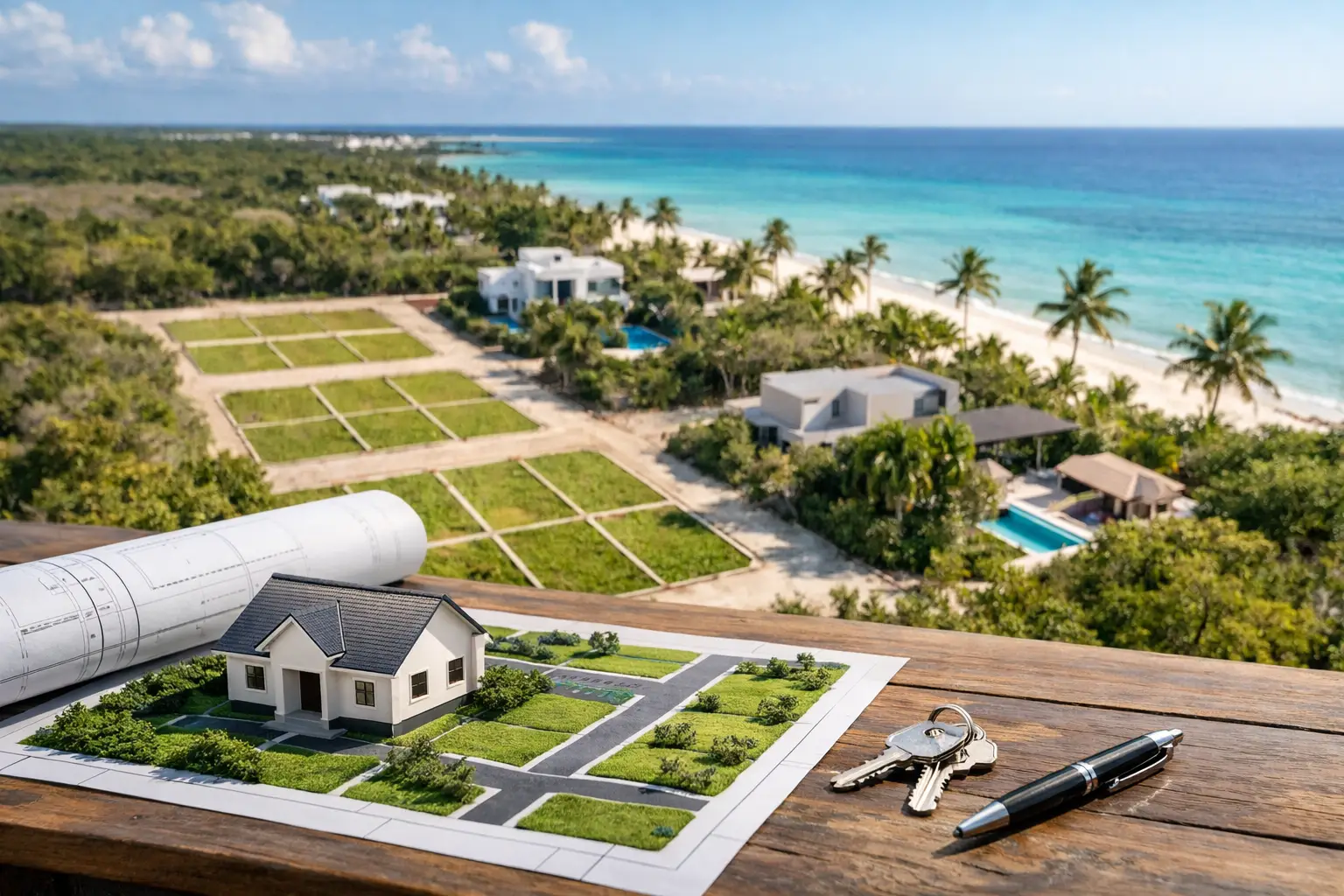
Buying land in Playa del Carmen is not a minor decision. Those looking for residential lots in Playa del Carmen are usually between two very specific objectives: to protect their capital in an area with sustained growth or to secure a space to build freely, at their own pace and with a clear patrimonial vision. The problem is that, from the outside, almost everything looks like a good opportunity. And it is not.
A well-chosen lot can give you equity, design flexibility and a better relationship between entry price and future potential. A poorly chosen lot can leave you tied to a weak location, hidden costs or a development that promises more than it delivers. That’s why it pays to look beyond price per square foot.
What makes residential lots in Playa del Carmen attractive?
Playa del Carmen continues to be one of the most watched markets in the Riviera Maya for a simple reason: it combines real demand for housing, tourist attraction, connectivity and urban sprawl. That creates an environment where residential land can gain value over time, especially when it is in corridors with developing infrastructure and reasonable access to services.
Unlike a finished apartment, a lot gives you leeway. You can buy today and build later, tailor the project to your needs or enter at earlier stages at more competitive prices. For many asset buyers, that flexibility weighs as much as profitability.
However, not all lots are suitable for the same profile. There are those who prioritize building a retirement home, those who are looking for a second home and those who are thinking about future resale from the beginning. The key is to align the land with the real use, not with a generic commercial promise.
Location still rules, but not in the way many believe it does
When it comes to location, many buyers are left with only the distance to the beach. This is a valid criterion, but incomplete. In residential lots, both the immediate surroundings and the projection of the area in three to seven years are important.
There are areas where the value does not depend on being a few minutes from the sea, but on having fluid access, proximity to schools, stores, hospitals, services and well-planned residential communities. The quality of the development also has an influence: real urbanization, adequate density, internal regulations and maintenance.
A cheap lot in a poorly connected area may still be cheap five years from now. On the other hand, a lot with better urban planning, even if it enters with a higher ticket, may perform better in capital gains and be easier to resell.
What to check in the area before deciding
Rather than getting carried away by the map in the brochure, it is a good idea to check whether the development has functional roads, lighting, electricity, water, drainage or a viable sanitary solution, and clear access from consolidated avenues. It is also important to understand what is around, not just what the developer says there will be.
If the environment depends entirely on future promises, you have to put that investment in perspective. It does not mean that it is a bad buy, but it does mean that the risk is higher and the return horizon may be longer.
What defines a good residential lot
A good lot is not just the cheapest or the largest. It is the one that balances location, documentation, land use, maintenance costs and exit potential. In Playa del Carmen this is especially important because there are very different developments, even if they are advertised under the same investment discourse.
The first filter must be legal and documentary. The land must be clearly deeded, with no ambiguities about ownership, regime or delivery conditions. If you are a foreign buyer, you must also review the appropriate legal structure for the acquisition, normally by means of a trust when it applies to a restricted zone.
The second filter is urban planning. It is not enough for it to be residential. You have to know what you can build, how many levels you can build, what percentage of floor area is allowed, if there are architectural guidelines and what limitations there will be for renting, selling or modifying in the future.
The third filter is financial. Some lots seem affordable because they offer comfortable monthly payments, but the total cost goes up significantly when considering down payment, installments, deed expenses, maintenance fees and possible subsequent construction costs. Buying well also means understanding the full commitment, not just the down payment.
The role of surplus value: expectation yes, fantasy no
In this market there is a lot of talk about capital gains, and rightly so. But a reasonable expectation is worth more than an inflated figure. The capital gain on residential lots in Playa del Carmen depends on several factors: stage of entry, actual progress of the development, consolidation of the area, demand for housing and perception of security for the future buyer.
Entering pre-sale or early stage may be attractive, but it’s not always the best option for everyone. If you are looking for a bigger discount and can wait, it makes sense. If you prefer certainty, you may want to pay a little more for a development with advanced urbanization and visible operation.
It must also be understood that the capital gain does not materialize on its own. The sale of a lot depends on the product remaining desirable. If the development accumulates low occupancy, poor management or half-baked infrastructure, the theoretical value may not translate into a real sale.
Buying to build or to invest: not the same thing
This is where many buyers get their objectives mixed up. If your intention is to build a home, you must prioritize functionality, regulations, lot orientation, privacy and livable environment. If your objective is investment, you should also think about future liquidity, resale ticket and profile of the next buyer.
There are lots that are ideal for a large house, but less liquid for resale because their final construction price places them in a very limited segment. There are also more compact lots in better positioned communities that, without being spectacular, can have a more agile exit due to demand and accessibility.
It is not a matter of choosing between equity or profitability. It’s about knowing which weighs more in your case. When that answer is clear, the choice is much better.
Common risks to avoid
The most common mistake is to buy on impulse. Attractive photos, promises of growth and payment facilities can accelerate the decision, but a lot is defended with analysis, not enthusiasm. If you don’t have clarity about delivery, deed, services and future costs, you’re not yet ready to buy.
Another common risk is to assume that all developments work the same. This is not the case. They vary greatly in quality of execution, level of maintenance, community profile and administrative seriousness. Two projects with similar prices can behave very differently in the medium term.
It is also wise to avoid the idea that a lot will always be a passive investment. Even if you don’t build right away, there are maintenance costs and administrative obligations. And if you do build, the project requires time, budget and follow-up.
How to make a sound decision
The best buy usually comes from an honest comparison of several real options, not from falling in love with the first one. It pays to review at least three developments with varying levels of consolidation, understand the total cost of entry, and put your objective in writing: build, resell, preserve capital, or combine several goals.
If you buy from another city or from abroad, local advice makes a huge difference. Not for convenience, but for control. A good broker not only teaches inventory. He filters, questions, validates documents, lands scenarios and helps you buy with clarity, without fear and with strategy. That is precisely the value of a professional accompaniment such as the one provided by Roberto Reyes Real Estate Broker in the Riviera Maya.
Questions you should ask before booking
Before you reserve any lot, ask for specific answers. What exactly is included in the price? When is it deeded? What services will be operational and in what time frame? What is the current or estimated maintenance fee? What are the building regulations? Are there any penalties, restrictions or special resale conditions?
If any of these answers are diffuse, constantly changing or rely only on verbal promises, caution is warranted. In an equity transaction, transparency is not an extra. It is part of the product.
Playa del Carmen continues to offer interesting opportunities for those who know how to read the market and do not buy blindly. A residential lot can be a solid base for your patrimony or an investment with a long way to go, but only when the decision is based on location, documents, numbers and real purpose. The good news is that, with the right analysis, buying land here can stop being a gamble and become a well thought-out move.


