
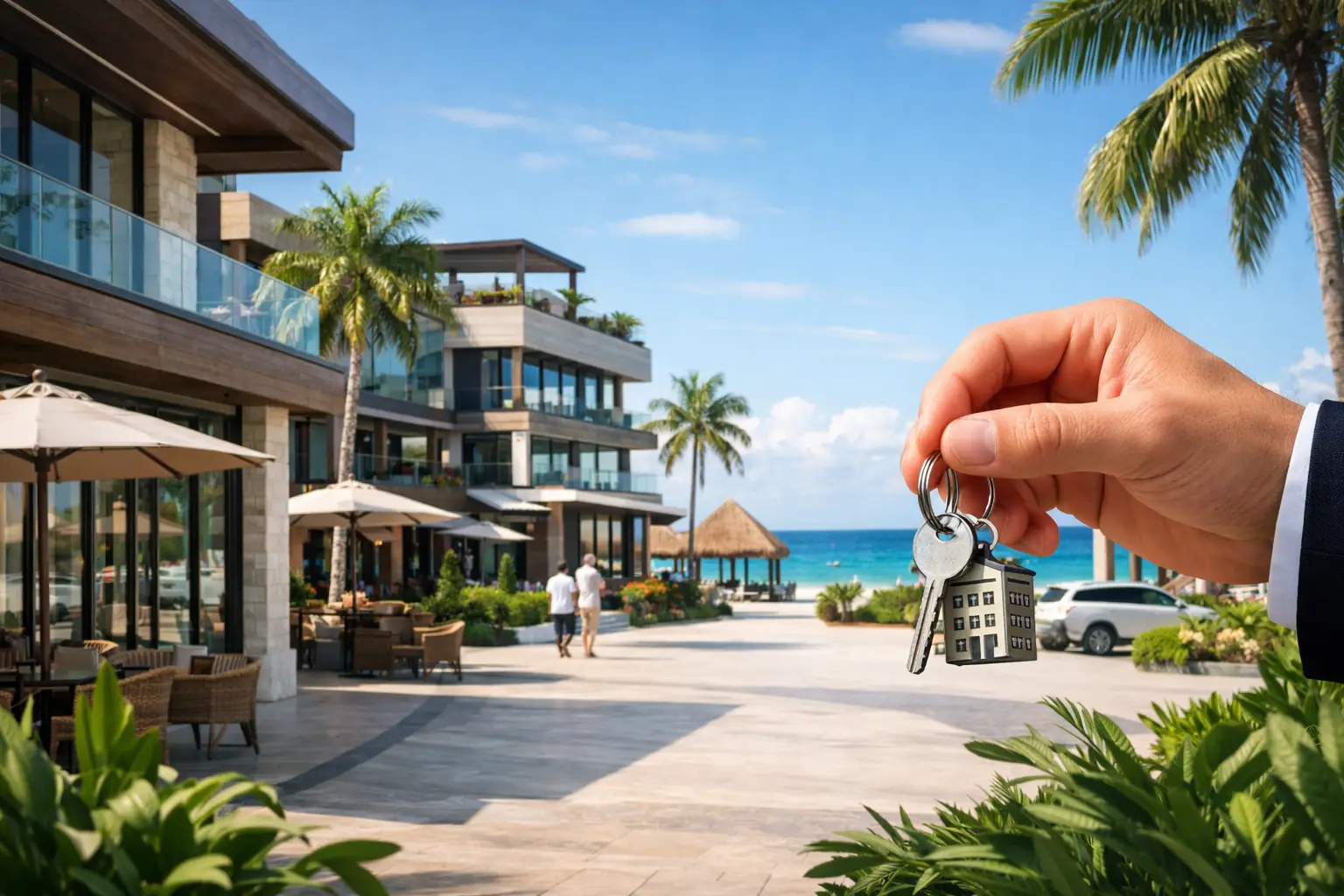
There is a big difference between buying a place because “the area looks good” and buying it because you understand how the tourist flow moves, what type of client consumes there and how much real margin it can leave you after expenses. In the case of commercial properties in Riviera Maya, that difference often separates a promising purchase from an investment that falls short.
Whoever is looking for this type of asset does not normally want to improvise. They want to protect capital, generate income, enter an area with growth and make a decision that makes sense today and also in five or ten years’ time. And that is where it is convenient to lower the enthusiasm, look at the numbers and analyze each location with criteria.
What makes commercial properties in Riviera Maya attractive?
The Riviera Maya has something that few markets have at the same time: constant tourism, residential growth, investment arrivals and an international profile that expands demand. This opens up opportunities for commercial space, small offices, service spaces, medical offices, restaurants, urban warehouses and units within mixed-use developments.
But not all premises in a tourist area work in the same way. There are properties designed to capture immediate visitor consumption and others that depend much more on the permanent resident. That difference completely changes the analysis. A location on a high-traffic avenue may seem more attractive than one in an established residential community, but if rents are too high or business turnover is constant, the risk also goes up.
Therefore, when we talk about value, it is not enough to look at square meters and starting price. It is necessary to understand the real demand for the product, the stability of the environment and the ease with which the space can be placed or rented.
Playa del Carmen, Tulum and Puerto Morelos do not play the same game
Playa del Carmen continues to be one of the most active markets for commercial investment because it combines tourism, local life and urban growth. Here, spaces oriented to services, wellness, gastronomy, convenience and attention to temporary and permanent residents tend to make sense. The attraction lies in the liquidity of the market, although it is also necessary to be more demanding with the entry price because the best positioned areas already reflect a good part of their capital gain.
Tulum offers a different logic. It has a powerful global brand and a demand that favors concepts with identity, design and experience. That can translate into interesting rents, but also greater volatility. In Tulum, exact location matters a lot more than many buyers think. A poorly positioned location within a corridor with little real operation can take longer to stabilize, even if the project looks attractive off-plan.
Puerto Morelos tends to interest a more strategic and patient profile. It does not always have the media buzz of other destinations, but that is precisely why it can open more reasonable entry windows. In certain cases, commercial properties here make sense for those who prioritize orderly growth, less saturation and a medium-term vision.
What type of commercial property can fit your objective
Not all commercial investments have the same goals. There are buyers who seek stable monthly rent and others who prefer to acquire a space to operate their own business. There are also those who buy pre-sale to capture capital gains before delivery.
A street-level location can work very well if there is visibility, pedestrian passage and a healthy mix of anchor businesses around it. A space within a small plaza can offer control and some operational structure, although much will depend on the overall occupancy of the project. Compact office or office space has a different rationale: less exposure to direct tourism and more linkage to population growth, professional services and the resident foreign population.
There is no universal answer here. It depends on whether you prioritize flow, appreciation, own use or output flexibility. The clearer you are about that from the start, the easier it will be to filter options and avoid purchases that look good in photos but don’t fit your strategy.
How to analyze an opportunity without getting carried away by emotion
The first filter should be location, but really understood. Not only if it is “close to everything”, but what kind of demand exists there, at what hours there is movement, what businesses are already operating successfully and if the environment will continue to improve or if it can become saturated. Sometimes a well-connected side street offers a better balance between price and profitability than an overpriced avenue.
The second point is the product. There are very nice premises that have poor commercial functionality: small fronts, poor visibility, uncomfortable access, insufficient parking or difficult distribution for multiple turns. This limits both leasing and resale.
Then come the numbers. You should review price per square meter, expected rent, maintenance expenses, taxes, probable vacancy period and cost of suitability. If you are buying to rent, don’t just look at the seller’s projected yield. What is important is the realistic yield after deducting expenses and downtime.
And then there is the legal part, which for many foreign buyers makes the difference between moving forward with confidence or slowing down. It is necessary to verify the property regime, land use, licenses if applicable, development status, delivery of common areas and conditions of sale and purchase. If you are a foreigner, you must also review the acquisition structure correctly, including the trust when applicable.
Common risks in commercial properties in Riviera Maya
One of the most common mistakes is to buy with tourism in mind. Tourism helps, but a solid business asset usually also relies on local people, foreign residents and services of real need. If everything depends on high seasons, the investment may become more sensitive than expected.
Another risk is paying a premium for marketing. In this region there are very well presented projects that sell a powerful idea, but that does not always mean that the location has a verifiable demand. Design matters, of course, but it is no substitute for a good commercial operation.
It is also advisable to be careful with presales. They may offer attractive prices and interesting capital gains, but they require a detailed review of the developer, delivery times, penalties, the master plan and the commercial viability of the complex. Buying before can give you an advantage or tie up capital longer than expected. It depends on the project.
When does it make sense to invest
It makes sense when you buy in an area whose demand you can explain with concrete arguments, not intuition. It makes sense when the entry price is related to the likely income and the market’s capacity to absorb that space. And it makes sense when your investment horizon is aligned with the asset.
If you are looking for fast and immediate cash flow, maybe not all development options are for you. If you prioritize capital gain and early entry, a well-studied pre-sale may be a good fit. If you want to open your own business, the analysis changes again: daily operations, exposure and the consumer profile that will pass through that location are more important.
That’s where real advice brings value. It is not about showing you twenty options, but about filtering three or four that really respond to your budget, your risk profile and your objective. Roberto Reyes Real Estate Broker works precisely from that logic: to help you buy with clarity, without fear and with strategy.
What you should ask before making a decision
Before setting aside a commercial property, ask for information that will allow you to make an informed decision. Clear floor plans, cost breakdown, property regime, land use, delivery schedule if applicable, maintenance expenses and real references of commercial absorption in the area. If there is a rent projection, ask where it comes from and if it is supported by comparable operations.
It is also worth reviewing the less optimistic scenario: What if it takes you longer to rent? What if you need to retrofit the space? What if project management does not achieve the expected occupancy? A good asset still makes sense even when the market is not behaving perfectly.
The best buy is rarely the most spectacular. It’s usually the one that withstands uncomfortable questions, the one that fits your strategy and the one you can hold with peace of mind. In Riviera Maya there are real opportunities, but good decisions are not born of haste. They come from understanding the terrain, reading each area well and buying with a cool head and a long-term vision.


