
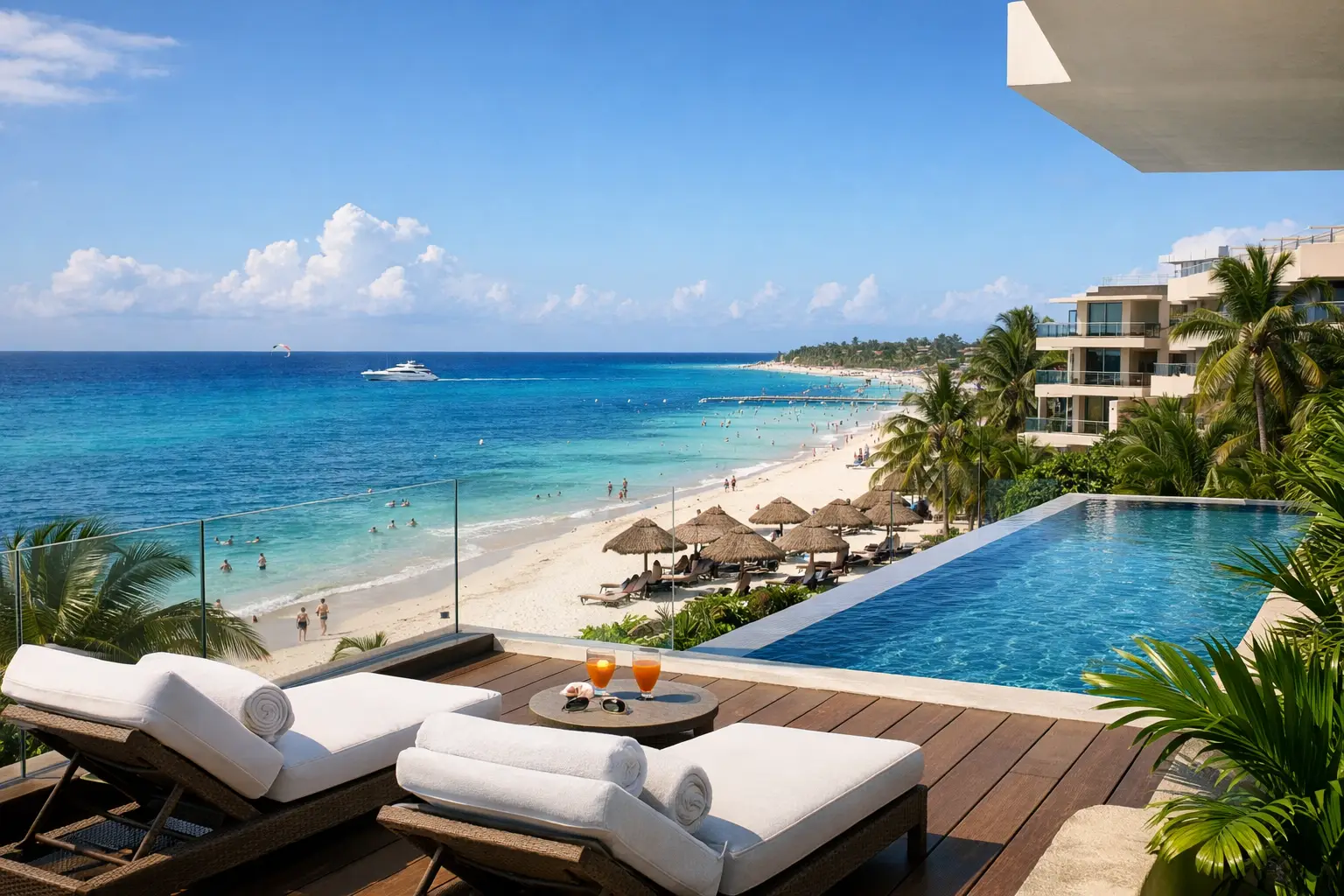
There is an important difference between buying for enthusiasm and buying with criteria. In a second home in Playa del Carmen, that difference is usually noticed in three very concrete things: how much you enjoy the property, how much it costs you to maintain it and how easy it is to sustain it over time without it becoming a burden.
Playa del Carmen attracts very different profiles. Some people are looking to spend long periods of time by the sea and work remotely. Others want a property for family vacations, with the idea of renting it when they do not use it. There are also those who are already thinking about a more serious transition: to partially retire, spend winters away or diversify their assets in a city with constant residential and tourist demand. The problem is that these three motivations do not require the same type of purchase.
What does it really mean to have a second home in Playa del Carmen?
A second home is not just a house outside your usual city. It is a property decision that mixes lifestyle, liquidity, operating costs and long-term vision. In Playa del Carmen, moreover, a market that has grown strongly comes into play, but that also requires a good reading of the location, property management and demand behavior.
That’s why it pays to ask an uncomfortable question at the outset: do you want it for real use or to justify an investment? Many purchases are complicated when the buyer tries to have one property solve everything at once. They want to live in it, rent it, retire there later, pay low expenses and have high appreciation. Sometimes that happens. Many others, it doesn’t.
If the primary objective is personal, the priority should be operational convenience: access, maintenance, security, proximity to services and ease of use. If the objective is mixed, with seasonal use and vacation rentals, then the variables change: building regulations, management, entrance ticket, furnishings, occupancy and marketing costs.
What buyers of second homes tend to value most highly
Whoever buys a second home in Playa del Carmen does not usually think the same way as a pure investor. They care about the return, yes, but they also care about the experience. They want to arrive and feel that the property works without friction. That there are no surprises with the administration. That the building is well maintained. That the area maintains life all year round and does not depend entirely on high seasons.
In that sense, Playa del Carmen has a clear advantage: it combines daily life with tourist activity. That means that not everything revolves around the occasional visitor. There are supermarkets, schools, hospitals, coworkings, restaurants, services and residential communities with diverse profiles. For a second home, that mix is usually more stable than a destination designed almost exclusively for short vacations.
Even so, not all areas respond in the same way. There are areas more oriented to short-stay rentals, others with a more residential rhythm and some that have changed a lot in a few years due to densification, traffic or new constructions. Buying just for a nice picture or for proximity to the sea can be expensive if you do not evaluate how the area is really lived in high season, in low season and in three or five years.
Zones and product: not everything fits the same profile
Here appears one of the most delicate decisions: choosing between apartment, townhouse, villa or even a lot to build later. Each format has a different logic.
A well-located apartment is often the easiest entry point for someone who lives away and wants a practical operation. It is easier to maintain, simpler to close for long periods and, in many cases, easier to rent. The cost is less privacy and greater dependence on condominium management. If the building is poorly managed, the owner’s experience quickly suffers.
A townhouse or villa offers a more personal experience, especially for families or those who spend long periods of time. The extra space and the feeling of home weigh a lot. But the responsibilities also increase: gardening, pool, exterior maintenance, support staff and constant supervision if you don’t live there year-round.
Building can make sense for a very specific profile, especially if the priority is to design a custom home and the local process is well understood. But it is not usually the simplest route for those who are looking for a second home that is operational in the short term. It requires more time, technical follow-up, margin for unforeseen events and a greater tolerance for wear and tear in the process.
The most common mistake: buying with only the entry price in mind.
In Riviera Maya, the purchase price is only part of the equation. To properly value a second home, you have to look at the whole picture: notary fees, equipment, maintenance fees, insurance, insurance, furnishings, air conditioning, repair fund and, if applicable, rental administration costs.
A seemingly more affordable property can be significantly more expensive in practice if it requires a high fee, if it needs a lot of refurbishment or if the rental operation depends on intensive management. The reverse is also true: properties with a higher initial price may perform better if they are in well-maintained communities with consistent demand and a clear operating structure.
Here it is convenient to be especially cold with the numbers. If you plan to rent it when you don’t use it, don’t calculate with perfect occupancy or peak season rates. Work with conservative scenarios. Ask how much it really costs to keep it empty, how much it costs to operate it occupied, and how much you have left over after commissions, cleaning, replacement and wear and tear.
Playa del Carmen second homes and vacation rentals
Vacation rent can help offset costs, but it should not be the only buying argument. It works best when the property already makes sense on its own. That is, when even without extraordinary income it is still a sustainable decision for your wealth.
Moreover, not all buildings allow the same model. Some are designed for short stays; others prioritize a more residential coexistence and restrict certain uses. That point needs to be reviewed before signing, not after. The size of the competing inventory in the area also matters. If you buy in a saturated segment, the pressure on prices and occupancy may be greater than expected.
There are buyers who are more comfortable with a hybrid model: using the property several months out of the year and renting it only at very specific times. That strategy can make sense if the main objective remains personal. The important thing is not to disguise an emotional purchase as a purely financial investment. They are different decisions and should be analyzed differently.
What a buyer should review before making a commitment
Beyond the property, there are four layers that deserve serious attention. The first is legal: ownership, rules, regulations, documentation and, in the case of foreigners, the right structure to buy safely. The second is operational: who manages it, how it is maintained and what happens when you are not there. The third is urban: what is being built around it, how mobility is evolving and what kind of new offer can affect your experience or your rental capacity. The fourth is financial: not only how much it costs to buy, but how much it costs to sustain without stress.
At this point, having local support makes a real difference. Not because of commercial pressure, but because there are details that are difficult to see from a distance: the profile of the neighborhood, seasonal noise, the quality of the management, the rate of absorption of an area or the difference between a pre-sale promise and an asset that is already in operation.
A platform such as Roberto Reyes Real Estate Broker makes sense precisely there: filtering information, providing context and helping to ensure that the purchase does not depend on intuition, but on a clearer reading of the market.
When does it make sense to buy and when should you wait?
Buying usually makes sense when you already know well how you want to use the property, you have a multi-year horizon and you can assume the operation without depending on an uncertain income. Also when you find a product aligned with your real life, not an idealized version of it.
Waiting can be a smart decision if you don’t yet know how many weeks a year you will spend in Playa del Carmen, if your budget is too tight, or if you keep comparing profiles of very different areas. Sometimes renting for a long period or two before buying gives tremendous clarity. It allows you to understand commuting, noise, climate, amenities and daily habits without still being burdened with an equity decision.
Buying a second home should not feel like a race. Nor should it feel like a blind bet that the market will work out any bugs. When done right, it is a valuable piece of a life and wealth strategy. When done in haste, it can become a property that demands more than it delivers.
Playa del Carmen continues to be a city with real appeal for those looking to combine personal use, flexibility and heritage vision. The key is not to buy before others, but to buy something that will still make sense to you when the initial excitement wears off. That’s where a good decision starts to look less like a purchase and more like a well-built stage.


