
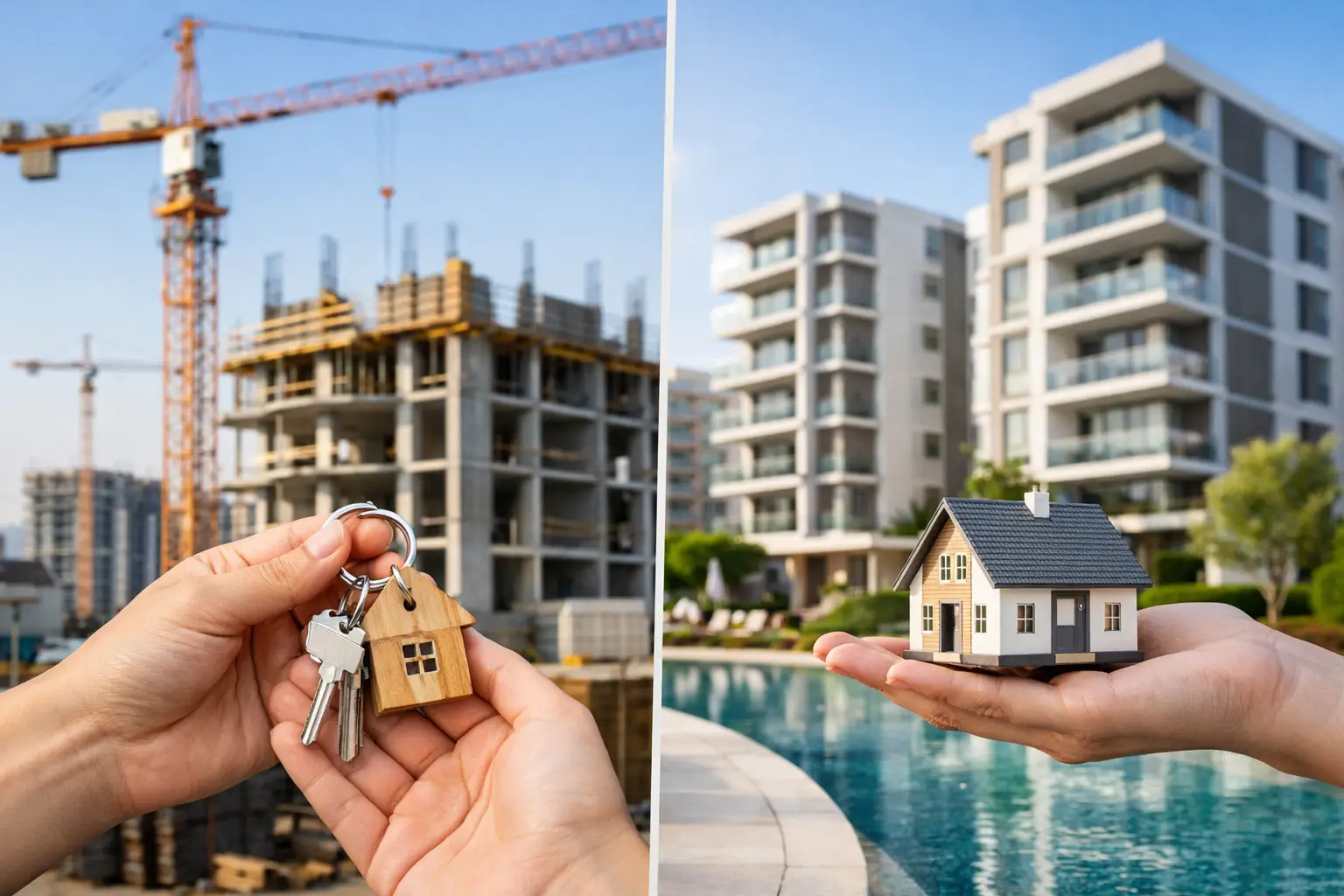
There are real estate decisions that seem simple until time comes into play. That is when the question of pre-sale or immediate delivery ceases to be a commercial detail and becomes a real estate decision. In markets like the Riviera Maya, where urban growth, tourist demand and the diversity of buyer profiles coexist at the same time, choosing the wrong moment of entry can affect both your profitability and your peace of mind.
The conversation is often framed in a narrow way. Presale equals “buy cheaper” and spot delivery equals “buy without waiting”. Both ideas have some truth to them, but they are far from telling the whole picture. What really matters is how each option aligns with your objective, your risk tolerance, your investment horizon and how you plan to use the property.
Presale or immediate delivery: the real difference
The most visible difference is in the timing, but it is not the most important. In a pre-sale you buy a property that is still under construction or even in the initial phase of commercialization. In an immediate delivery, you acquire a finished property, ready to be deeded, inhabited or put into production, as the case may be.
So much for theory. In practice, pre-sale buys future time and immediate delivery buys present certainty. That distinction completely changes the financial conversation.
In pre-sales, the buyer is betting on a value curve that has not yet fully materialized. He can obtain better starting prices, more flexible payment plans and a margin of appreciation during construction. In exchange, he assumes variables that he does not fully control: progress, timing, project adjustments, quality of execution, developer management and market conditions when delivery arrives.
With spot delivery, the buyer eliminates many of those unknowns. He sees what he is buying, reviews actual finishes, better understands operating costs and can activate the asset in less time. The price of that certainty is usually a higher down payment and less structural negotiating leeway.
When presales make the most sense
Presale tends to work best for those who have a strategic vision and do not need immediate liquidity from the property. It is a reasonable option if you are looking to build equity patiently, enter a growing area before it fully matures, or spread the payment over the construction phase.
In Playa del Carmen, Tulum or Puerto Morelos, this can be relevant when an area is still consolidating access, services or residential demand. Buying before the environment reaches a certain urban maturity may make sense, but only if you understand what is driving that growth and what risks are still open. Not every early stage project ends up capturing the value promised in the prospectus.
The great advantage of pre-sales is not only the initial price. It is the possibility of entering a stage where the market has not yet fully discounted the expected growth. That can translate into capital gains, yes, but also into better payment terms and less pressure on your monthly cash flow during the purchase.
However, it is important to curb enthusiasm. A well-bought presale is not just any presale. There is a huge difference between a project with clear permits, a solid financial structure, verifiable progress and a product aligned with real demand, and one that depends on expectations that are difficult to sustain. When the buyer is far away, especially if they come from the United States, Canada or another city in Mexico, this prior review is no longer recommended and becomes indispensable.
The hidden cost of waiting
Waiting also costs. During the construction period you cannot live in the property, rent it or use it as an immediate patrimonial refuge. If your plan depends on vacation rental income or a move on a specific date, the pre-sale can generate a significant gap between expectation and reality.
There are also less visible costs: updating the budget for furnishing later, deed expenses that materialize later, possible start-up maintenance fees, and the risk that the market will change when you take delivery. If you buy with the idea of reselling on delivery, you need to understand that this scenario depends on the competing inventory available at the time, not the enthusiasm of the day you set aside.
When prompt delivery is usually smarter
Immediate delivery is usually the most sensible option for those who prioritize control, clarity and fast execution. If you want to live in the property, retire in the short term, generate rents as soon as possible or avoid the operational risk of a construction site, it makes a lot of sense to pay for that certainty.
Here the evaluation changes. You are no longer buying a rendering or a promise of future absorption. You are analyzing real meters, orientation, finishes, community, regulations, maintenance costs, rental performance in the area and condition of the asset. The conversation becomes more concrete and less speculative.
For many heritage buyers, especially those who don’t want to devote energy to overseeing processes, immediate delivery reduces mental friction. And there’s value in that, too. Not everything is measured in terms of a down payment. Sometimes it pays more to buy a property that is already functional, even if the price is higher, if it avoids months of uncertainty or allows you to activate income in the short term.
What is sometimes overlooked
Immediate delivery does not always mean easy purchase. You may find finished properties with high maintenance, slow rental absorption, oversupplied locations or finishes that have aged worse than expected. You may also pay a significant premium for something that has already used up much of its appreciation path.
That is why it is important not to confuse “finished” with “convenient”. The advantage lies in visibility, not in automatic perfection. It is necessary to review numbers, urban context and realistic use of the property, just as in a pre-sale.
Pre-sale or immediate delivery according to your buyer profile
If you are buying to live in, immediate delivery is usually a better fit. It allows you to solve a specific need for a residence, to know the environment more precisely and to avoid having a move-in date depend on third parties. Presale would only make sense if your life change is planned well in advance and the project responds very well to what you are looking for.
If you are buying for medium to long term equity investment, pre-sales can be an interesting tool, especially if your capital is intended to appreciate and you do not need returns from the first month. Here the focus should be on the developer, the phase of the area’s cycle and the depth of future demand.
If your objective is vacation rentals or short-term rentals, immediate delivery has an obvious operational advantage. You can test the market, adjust rates, understand occupancy and correct strategy based on real data. Pre-sales, on the other hand, force you to estimate a future scenario that may change by the time you receive the property.
If you are a conservative buyer, immediate delivery will give you more peace of mind. If you have a higher tolerance for risk and know how to read product, location and timing, presale may offer better entry points. No one option is superior by definition. The best one depends on the type of problem you want to solve.
How to decide without buying in a hurry
The most useful way to answer the “pre-sale or immediate delivery” question is to stop thinking about the property first and think about your plan first. Do you need immediate use or can you wait? Are you looking for flow or value accumulation? Are you interested in financing in stages or would you prefer to close and operate now? Could you absorb a delay without it affecting your strategy?
Then it is a good idea to take an honest look at five variables: term, liquidity, risk tolerance, purpose of use and quality of the project or asset. When one of these variables does not fit, bad decisions usually appear. For example, buying pre-sale with the urgency of renting soon, or paying for immediate delivery without having validated whether the price already incorporates an excess compared to the market.
At this point, the right accompaniment makes a difference. Not to push you toward one option, but to filter out what really holds value. That’s the kind of analysis that changes an impulse purchase into a meaningful wealth decision.
In Riviera Maya, where new developments, expansion zones and ready-to-operate products coexist, the most common mistake is not choosing pre-sale or immediate delivery. The mistake is to choose without understanding what you are buying in terms of time, risk and strategy. Buying with clarity, without fear and with criteria, almost always gives better results than chasing the lowest price or the fastest delivery.
In the end, a good real estate purchase doesn’t start when you set aside. It starts when you understand what role that property should play in your life and your wealth.


