
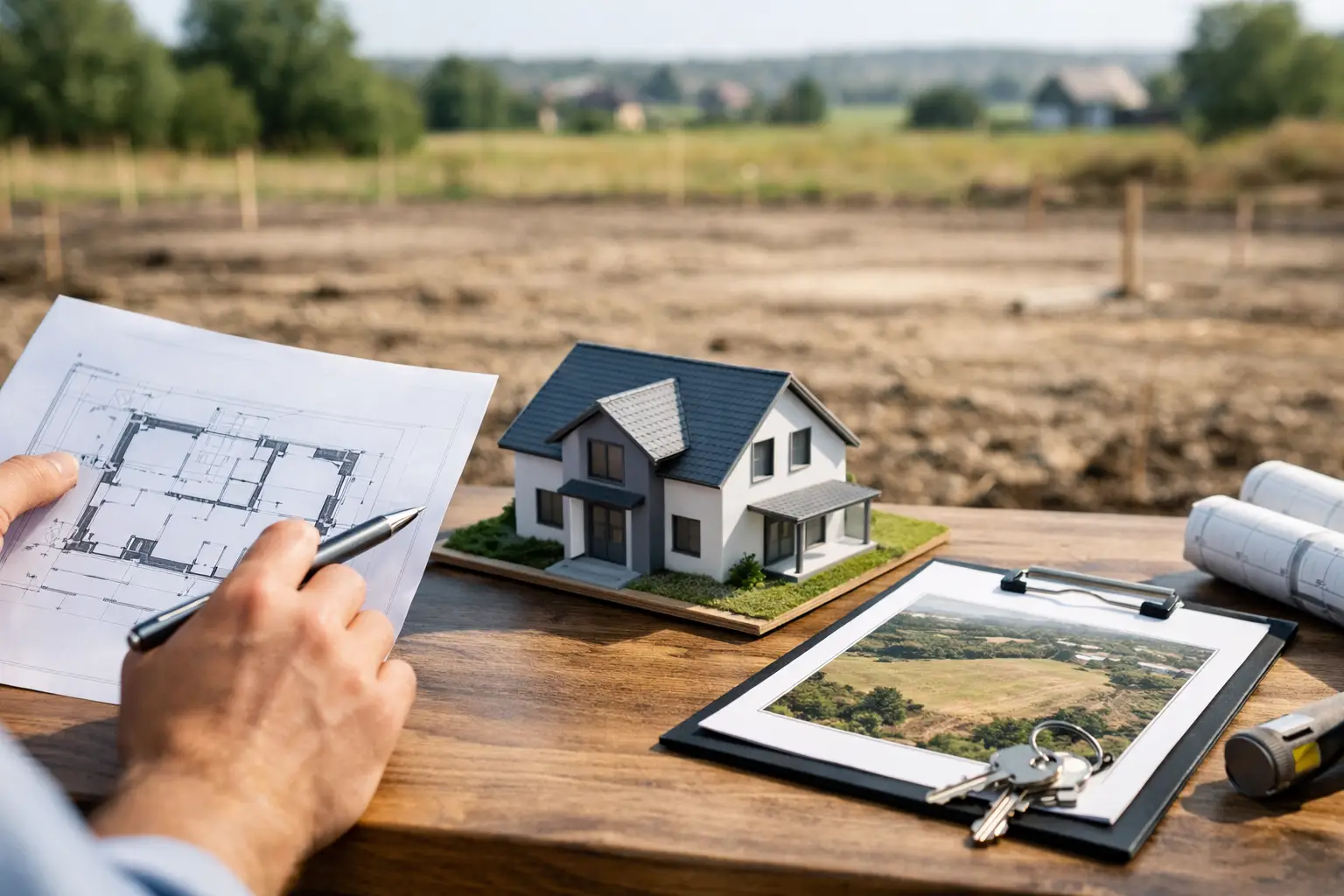
Buying a lot on paper sounds simple until the first serious question arises: can I build what I want there? When someone looks to me to understand how to buy land to build on, the problem is almost never finding options. The real problem is to filter out risks that are not seen in the photos, nor in the price per square meter, nor in the seller’s speech.
In Riviera Maya this happens a lot. I have seen attractive land in price that ends up being a bad buy because the access is not resolved, because the land use does not coincide with the buyer’s project or because the area still depends on a promise of infrastructure that has no clear date. A land is not evaluated only for what it costs today, but for what it allows you to do tomorrow.
How to buy land to build judiciously
The right question is not only where to buy, but for what purpose. It is not the same to buy land for a retirement home, a second home, a villa for vacation rentals or a heritage building to live in five or ten years from now. Each scenario changes the reading of the land.
If your objective is to build to live, the focus should be on services, real urbanization times, security, access and quality of the environment. If you are looking for investment, then the absorption of the area, the rate of urban growth, future demand and the total cost of exit, including construction, maintenance and commercialization, matter more.
This point seems basic, but it defines almost everything else. I have seen buyers fall in love with a lot in Tulum thinking of a retirement home and then discover that the dynamics of the area, the traffic or the tourist profile do not fit with the quiet life they imagined. I have also seen the opposite: people who buy thinking about renting and choose areas that are too residential, with little logic for a vacation operation.
Before setting aside, check what no one has explained to you well.
The thrill of fast parking often comes at a high price. Before making a down payment, it is necessary to validate several fronts at the same time: legal situation, urban feasibility and real cost of construction.
The first thing to do is to confirm ownership. It seems obvious, but it is not enough to see a deed or a property tax bill. It is necessary to check that the seller has the authority to do so, that the land is free of relevant encumbrances or limitations and that the documentation coincides with the physical reality of the lot. In well-conducted transactions, we also review the registry history and, when applicable, the development regime, internal regulations and construction restrictions.
The second thing is land use. This is where many plans fall down. A lot can be legally saleable and still not be suitable for your project. You must know the permitted density, COS, CUS, height, setbacks, setback percentage and if the municipality allows the type of housing or scheme you intend. In Playa del Carmen this can vary greatly between a planned community, a subdivision and an area of more irregular growth.
The third thing is real services. Not the promise that “soon there will be everything”. I am referring to electricity, water, drainage or sanitary solutions, roads, lighting and access during the rainy season. In many cases, a cheap piece of land is no longer cheap when you add the cost of providing infrastructure or adapting the project to the lack of services.
The price of the land is not the cost of the decision.
One of the most common misconceptions is that buying well means paying less per square meter. This is not always the case. Sometimes a more expensive land ends up being more profitable or safer because it reduces time, uncertainty and hidden costs.
When evaluating a purchase, consider the integral cost. In addition to the price, think about the deed, taxes, trust if you are a foreigner and the property is in a restricted zone, topographic survey, soil mechanics study, architectural project, licenses, perimeter fence if you need it and maintenance costs if the lot is within a private property.
There is also a silent cost: time. If you buy in an area where the infrastructure will take years or where the regularization process is slow, your capital is tied up longer than you planned. For some profiles this is not a problem. For others, especially if they want to build soon or generate cash flow, it completely changes the convenience of the purchase.
How to choose the area without buying only a promise
In Riviera Maya there is a lot of talk about growth, but growth does not mean the same thing everywhere. There are areas with orderly expansion and others where the market goes faster than urban planning. That difference matters a lot when you buy land.
In Playa del Carmen, for example, there tends to be more clarity in certain consolidated residential areas or within master-planned communities, where the buyer has a better understanding of regulations, services and environmental projection. In Tulum, on the other hand, it is advisable to be more careful because the attractiveness of the market has led many to buy on expectation, without analyzing access, density, permits and future operation with sufficient rigor.
Puerto Morelos and some parts of Cancun may make more sense for certain buyers who prioritize stability, connectivity and a less speculative pace. There is no universal answer. It depends on whether you want to build to live in, to rent or to preserve heritage with a medium-term vision.
The best area is not the one that makes the most noise, but the one that best aligns with your horizon, your total budget and your risk tolerance. That part almost never shows up in advertising, but it’s the part that weighs the most later on.
What to check on the ground, not just on paper
The documents matter, but the terrain is also walked. Seeing it in person greatly changes the reading. Topography, elevation, lot shape, solar orientation, soil type and relationship to abutters directly influence the cost and quality of the project.
An irregular lot may complicate the design and reduce usable area. A very low lot may require fill or additional hydraulic solutions. A short frontage limits garage, ventilation or facade. In jungle or rocky areas, soil mechanics and the type of foundation can move the budget quite a bit.
I have seen buyers focus so much on closing the purchase that they procrastinate on these questions. The problem is that they are no longer useful for negotiating. They serve only to regret or to spend more.
If you are a foreigner, the process changes a little
For foreigners, buying land near the coast in Mexico normally involves the use of a bank trust, unless the acquisition is made through certain structures permitted in specific contexts. This does not make the purchase complicated by definition, but it does require better legal coordination and documentary clarity.
The important thing here is not to improvise. You must understand who is accompanying you in the review, what notary and bank fees you will incur, what timescales are realistic and what the tenure of the property will look like. I have noticed that many foreign buyers feel comfortable with the land, but insecure about the process. That insecurity is greatly reduced when each step is explained without unnecessary technicalities.
Common mistakes when buying land for construction
The first mistake is to buy for visual excitement. A nice lot is not always a convenient lot. The second is to assume that if others have already built nearby, you will be able to do the same under the same conditions. The regime, the date of permits or the situation of the property does not always coincide.
The third mistake is not aligning land and construction budget. There are people who can buy the land, but they do not have enough margin to build with quality, healthy timing and contingencies. Then the lot stands still for years. This is not necessarily bad if it was a strategic decision, but it is bad if the original intention was to move soon.
Another common mistake is to delegate the entire evaluation to the salesperson. The seller may be professional and honest, but his role is not to do your thinking for you. Your analysis should include legal advice, technical review and market reading.
A smarter way to make the decision
If you really want to know how to buy land to build well, think in layers. First define the project and the time frame. Then filter zones. Then check legal and urban feasibility. Only then negotiate price. Not the other way around.
That order avoids many impulse purchases. It also helps you compare land that on paper looks similar, but in reality offers very different scenarios. One may be cheaper and more uncertain. Another may cost more, but give you better conditions to build, live on or sell later.
At Roberto Reyes Real Estate Broker we work a lot from that logic: not selling land out of enthusiasm, but helping to read context, risk and potential more coldly. Because buying land is not just about acquiring meters. It is about buying a real project possibility.
If you are about to take that step, it is better to ask ten uncomfortable questions before signing than just one when there is no turning back. A good land is not the one that sells easily. It is the one that allows you to build with clarity, without fear and with strategy.


