
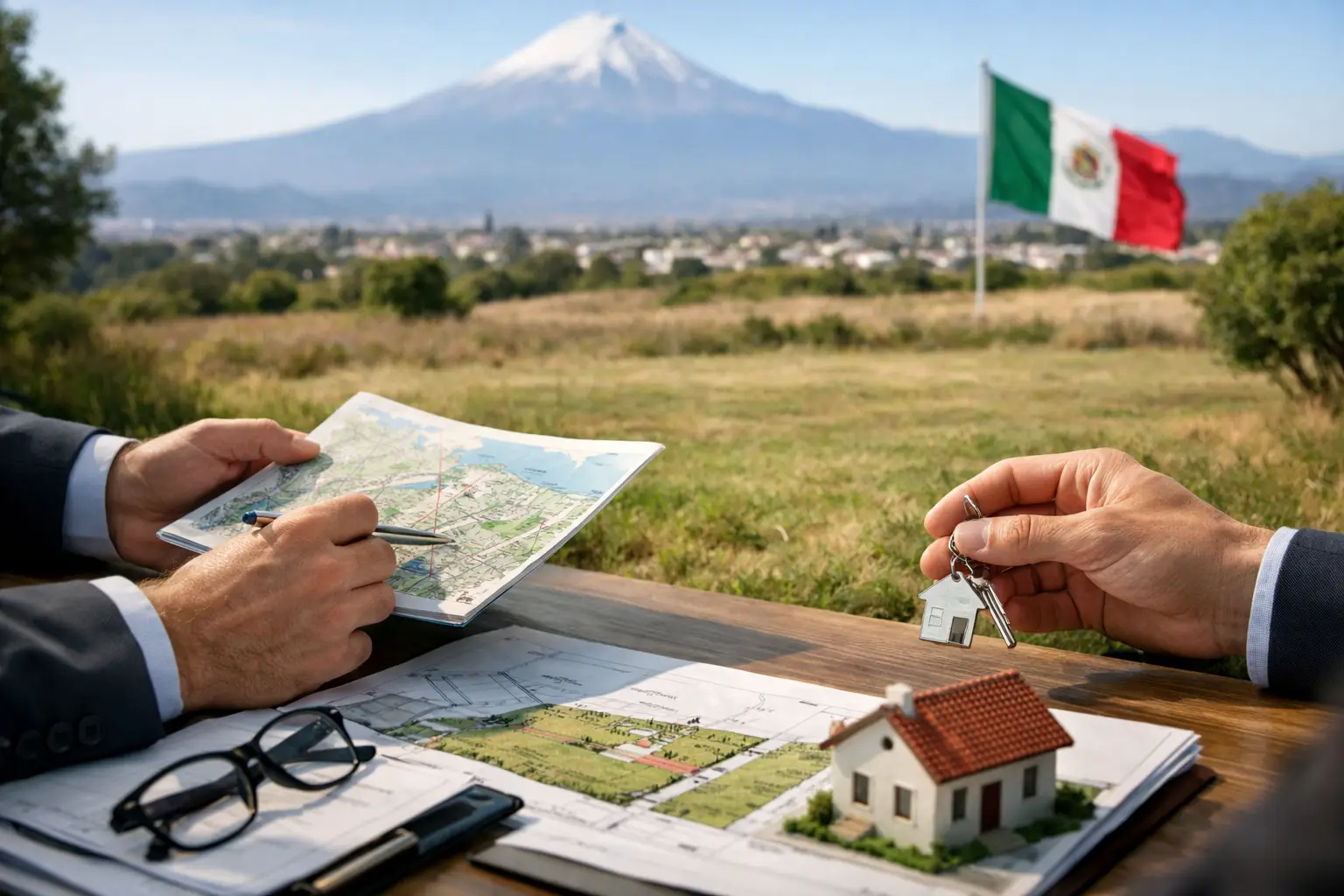
Buying land often seems simpler than it really is. There are no finishes to check, no kitchen to evaluate and, at first glance, it all comes down to square footage and price. That’s where a lot of mistakes start. This legal guide to buying land is designed to avoid decisions made out of enthusiasm, commercial pressure or incomplete information.
I have seen this problem many times in the Riviera Maya: someone finds an attractive lot, is promised that an avenue is almost coming in, that infrastructure will soon arrive or that the value will go up when the area is developed. Sometimes that happens. Sometimes it doesn’t. And between one thing and another, the only thing that must be clear from the beginning is the legal part. If that foundation fails, the rest of the plan – building, selling, renting or storing equity – is at risk.
What to check before setting aside
The first filter is not the project design or the commercial pitch. It is the legal status of the land. Before handing over a set aside, down payment or down payment, you need to confirm who the owner is, under what regime the property is located and if it can really be sold under the conditions you are being offered.
Not all land in Mexico is ready to be deeded immediately. Some are private property and the process can be relatively straightforward. Others come from the ejido regime, have incomplete regularization processes, or have a history that requires a much more thorough review. In Playa del Carmen, Tulum and peripheral growth areas, this point completely changes the level of risk.
It is also worth distinguishing something that many buyers overlook: it is one thing to buy land and another to buy land that is useful for your purpose. Legally it can be sold, yes, but that doesn’t mean you can build the house you envision, develop rental units or subdivide it later.
Legal guide to buying land: essential documents
If I had to boil it all down to one idea, it would be this: don’t buy based on renders, promises or WhatsApp screenshots. Buy with a file. A serious property must be able to stand on verifiable documents.
The basics start with the public deed or title deed duly registered in the Public Registry of Property. After that, it is necessary to review the certificate of freedom from encumbrances to know if there are any mortgages, liens, litigations or domain limitations. The current property tax is also important, not because by itself it guarantees legality, but because it helps to confirm administrative order.
In addition to this, the cadastral proof, official plans and measurements, and the identification of the owner or legal representatives if a company is selling. When the transaction is with a legal entity, it is necessary to review the articles of incorporation, powers of attorney and real powers to sell. It seems obvious, but not always the person who negotiates is legally empowered to sign.
If the buyer is a foreigner, the analysis of the restricted zone also comes into play. In most of the Riviera Maya this is resolved through a bank trust when applicable. It is not an obstacle, but it is a legal structure that must be well understood from the beginning, especially in terms of costs, time and responsibilities.
Land use is worth as much as the deed
This is where many get complacent. Having a deed is not enough. Land use defines what you can actually do with the land. And that fact changes the value of the asset more than any commercial promise.
If you want to build a retirement home, you need to verify density, floor area ratios, permitted levels, environmental restrictions and real access to services. If you are looking to build a small vacation rental project, the analysis must be even more precise. In certain areas of Tulum or corridors with sensitive environmental regulations, what the seller tells you and what the regulations allow do not always coincide.
In Playa del Carmen this is also very important in areas of urban expansion. I have seen land that is offered as ideal for patrimonial investment, but when you check the land use or urbanization conditions, the real term to take advantage of it is much longer than the buyer imagined. This does not mean that they are bad land. It means that you have to buy them with the right expectations.
Common risks that are almost never explained to you
One of the most frequent is to buy pre-sale lots without understanding if what exists today is a promise of future deed or a current legal capacity to transfer property. There are well-structured projects and others where marketing is several steps ahead of legal support.
Another common risk is to assume that “it is already regularized” because someone mentions it in the commercial presentation. Regularization is not presumed, it is proven. And when a land comes from an ejido background, the review must be especially careful. This is not because every property with this origin is problematic, but because the buyer needs complete documentary certainty.
There are also conflicts over access. A piece of land may legally exist, but if its entrance depends on poorly defined easements or unformalized roads, this affects its use, value and future liquidity. In areas of rapid growth this happens more than it seems.
And then there is the less visible risk: buying something cheap that you can’t easily sell later. Sometimes the problem does not appear when you buy it, but years later, when the next buyer or his notary detects gaps that nobody checked well at the beginning.
How to buy land well in practice
The healthy route usually starts with an offer conditional on documentary review. This allows you to move forward without blindly committing yourself. Then comes the integration of the legal file, the registry and cadastral verification, and the land use analysis. If everything is in order, you can move on to a well-drafted contract.
This contract must establish price, form of payment, terms, penalties, delivery of possession and suspensive conditions, if any. If there are deferred payments, it must be made very clear what happens in case of default, who assumes taxes, notary fees and trust costs when applicable.
The notary’s office does not replace the previous due diligence, but it is a key piece in the closing. A good notary reviews the formal legality of the transaction, calculates taxes, and notarizes the sale for registration. Even so, the buyer should not delegate all the investigation to the end of the process. The right thing to do is to arrive at the notary’s office with much of the work already cleared up.
If you buy to build, check one step further
When the objective is to build a house or develop something small, the purchase of the land cannot be separated from the subsequent technical cost. Topography, soil mechanics, feasibility of water, electricity, drainage or alternative systems, and condominium restrictions if it is in private regime. All this modifies the actual budget.
In Riviera Maya this weighs heavily due to the type of soil, vegetation, environmental regulations and infrastructure available in the area. There are lots that appear to be attractively priced, but require significant additional investment before a single block can be put in place. This is not a reason to automatically discard them. It is a reason to evaluate the entire operation, not just the entry ticket.
What changes for Mexicans and foreigners
For a Mexican buyer, the focus tends to be on legal certainty, taxes, payment methods and equity strategy. For a foreigner, there are also doubts about trust, residency, bank opening, origin of resources and operating times. None of these issues makes the purchase unfeasible, but they do require more precise coordination.
The tricky part is when they try to speed up the process without explaining these differences. I have noticed that many foreigners arrive with fear that everything is too complex, and many Mexicans from other cities arrive thinking that it is the same as buying in their state. Neither position helps. Every market has nuances, and on the coast those nuances matter quite a bit.
The most useful sign: have someone also explain to you why not to buy
Good land is not just land that can be sold. It’s the one that makes sense for your strategy, your timeline and your risk tolerance. If someone only talks to you about potential, growth and future, but avoids getting into documents, constraints and real costs, there is an essential part of the conversation missing.
The best legal guide to buying land does not seek to scare you. It wants you to buy with clarity. Sometimes that confirms that it’s worth moving forward. Other times it helps you walk away in time, which is also a good decision. In equity, avoiding a big mistake is often worth more than closing a purchase quickly.
If you are evaluating land in Playa del Carmen, Tulum or Puerto Morelos, look at it as a complete project and not just a land reserve. The right piece of paper, reviewed on time, is still more valuable than any well-told promise.


