
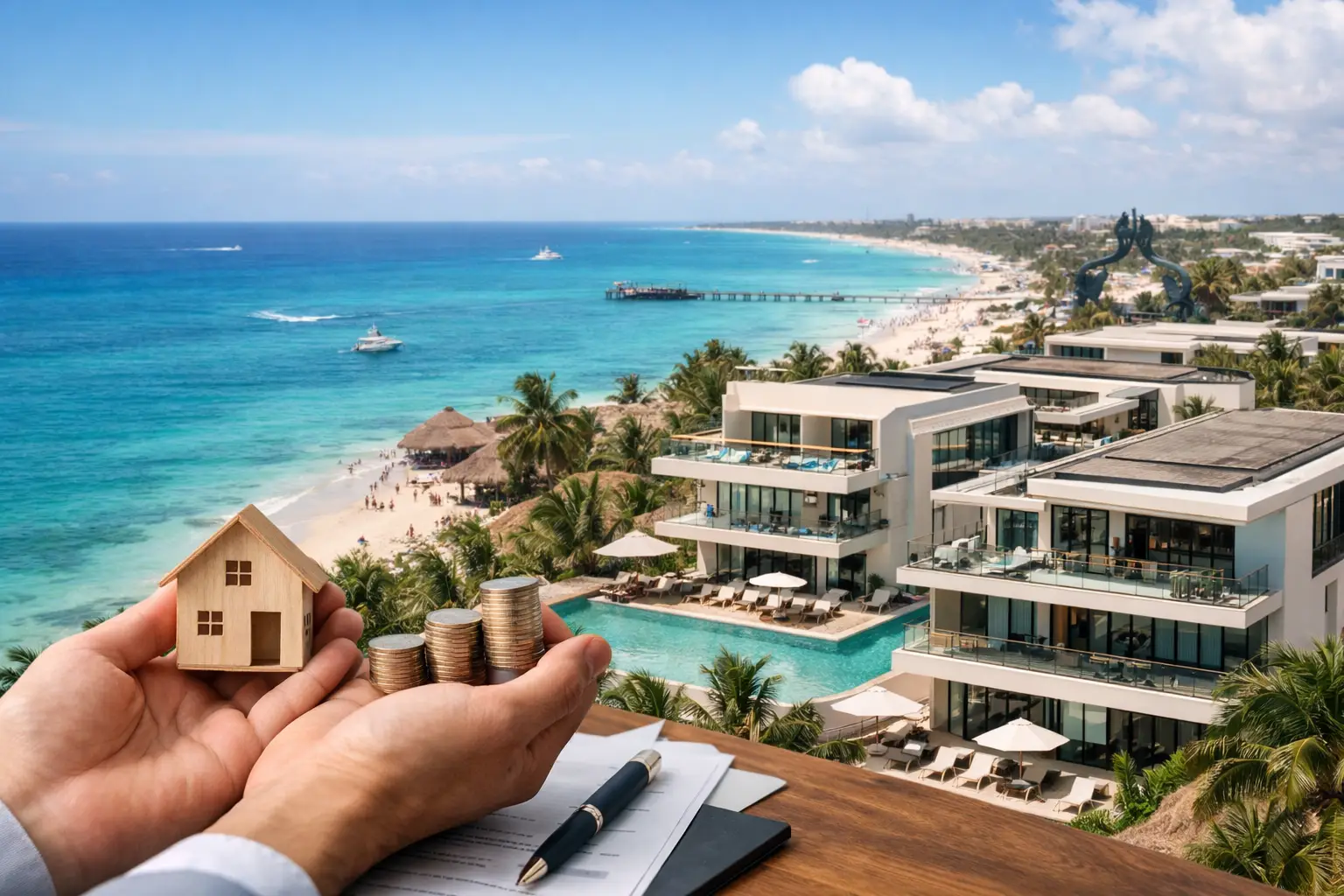
There are buyers who look at a property in Playa del Carmen and only see meters, finishes or proximity to the beach. The finer investor looks at something else: how likely it is that the asset will be worth more in three, five or ten years. That is where real estate appreciation in Playa del Carmen ceases to be a commercial promise and becomes a real purchase criterion.
Playa del Carmen has not grown by chance. Its demand combines international tourism, national migration, patrimonial buyers and profiles that look for profitability with vacation or mid-stay rentals. That pushes the market, yes, but not uniformly. Not every property rises equally, not every area matures at the same pace and not every “well presented” project is a good decision.
What does real estate appreciation in Playa del Carmen really mean?
Capital appreciation is the increase in value of a property over time. It sounds simple, but in practice it depends on several intersecting factors: location, infrastructure, demand, available inventory, buyer profile and quality of the development. So when someone asks if Playa del Carmen has capital gains, the honest answer is yes, but it depends a lot on where and what you buy.
In this market, capital appreciation does not usually come from just waiting. It comes from entering at the right time, choosing an area with fundamentals and avoiding projects that look attractive off-plan, but have no real ability to sustain value when delivered. Buying cheap does not always mean buying well.
It is also important to distinguish between capital gains and cash flow. There are properties designed to generate income from the beginning and others that make more sense as a medium-term capital investment. Sometimes they coincide. Sometimes they do not. Those who buy with a strategy understand this difference before signing.
Why Playa del Carmen continues to be an attractive market
Playa del Carmen maintains a combination that is difficult to find in other destinations: urban life, tourist attraction, regional connectivity and constant demand for temporary and permanent housing. It does not depend on a single type of buyer. That makes it more resilient than markets built solely around vacation tourism.
The Riviera Maya continues to attract private investment, new residents and service developments. Each improvement in connectivity, commercial offerings, infrastructure and urban facilities tends to push certain corridors. When a city gains functionality, it not only becomes more comfortable to live in. It also improves its ability to sustain prices.
However, rapid growth has a less comfortable side. At some points there is oversupply, especially in segments that are very similar to each other. This especially affects products without differentiation, in areas where too many units enter at the same time. That is why looking only at the tourist potential of Playa del Carmen is no longer enough. It is necessary to read the micro-market.
Areas with the greatest potential for capital appreciation
Talking about zones is more useful than talking about the city in general. In Playa del Carmen, a few kilometers can completely change the behavior of the asset.
Downtown and consolidated areas
Central areas and areas close to the beach remain attractive due to relative scarcity, liquidity and proven demand. They tend to have higher entry tickets and, in many cases, less scope for explosive growth than an emerging area. In return, they offer more predictable behavior. For conservative profiles, that weighs heavily.
The key here is not to overpay for “premium” locations that already discount all future expectations. A good operation in a consolidated area is not always the most attractive one, but the one that is well bought compared to real comparables.
Residential growth corridors
There are areas that have gained strength for their balance between entry price, connectivity and residential life. They are especially attractive for those who do not depend only on vacation rentals and are looking for an asset with a broader demand. When an area begins to consolidate services, access and resident community, the capital gain is usually based on something more stable than fashion.
These areas require more fine-grained analysis. It is not enough to hear that “it will grow”. It is necessary to check if absorption already exists, if projects are being delivered well and if urbanization is keeping pace with development.
Planned communities and well-segmented product
In Playa del Carmen, some planned developments offer a more orderly approach: security, consistent amenities, internal regulation and a more defined buyer profile. That can help sustain value over time, especially if execution is consistent.
But there are nuances here as well. Amenities are impressive at pre-sale, although they are not always what the market values at resale or rental. Sometimes a well-managed community brings more value than a long list of little-used extras.
What are the real drivers of capital gains?
The first lever is functional location. It’s not just about being close to the beach. Access, mobility, proximity to amenities, perceived safety and perceived security, and actual ease of use for resident or guest also matter. A pretty address on the map does not always work well in practice.
The second is the timing of entry. Buying pre-sale can provide room for appreciation, but only if the developer is solvent, the starting price is well positioned and the area is really absorbing inventory. If you go into a project inflated from the start, pre-sale is no longer an advantage.
The third is product quality. Efficient layouts, reasonable maintenance, professional management and a proposal aligned with demand weigh more than many buyers think. At resale, the market is quick to punish design errors and excessive maintenance costs.
The fourth is scarcity. In tourist markets, scarcity pays off. Views that are difficult to replicate, truly walkable locations, well-resolved typologies or properties with a very specific profile tend to stand up better to competition.
Mistakes that hinder real estate capital gains in Playa del Carmen
The most common mistake is to buy for emotion and then justify it with numbers. A property can be a great investment and still be a bad investment. If the price is out of market or the area is still without fundamentals, the risk increases even if the rendering is impeccable.
Another mistake is to assume that everything new will go up in value. Not necessarily. When an area fills up with almost identical units, competition puts pressure on prices and complicates resale. The novelty is short-lived. The real value is measured later, when the project is already competing with other completed projects.
Those who do not understand total cost of ownership also fail. High maintenance fees, poor management, operational constraints or miscalculated closure costs can affect both profitability and the perception of future value.
And there is a key point for foreign buyers: not checking the legal structure of the purchase. The figure of the trust, the documentation of the development, the permits and the property regime are not minor formalities. They are part of the security of your investment.
How to evaluate if a property has real potential
The first thing is to compare price per meter with operations and competing offers in the same area, not with promises from other neighborhoods or with the seller’s speech. The right context matters. An asset is not worth more because it is presented better, but because the market is willing to pay for it.
Then it is important to analyze the depth of demand: is the property of interest to a broad profile or a very specific one? The larger the potential buyer or tenant base, the more liquid the asset tends to be.
It is also necessary to review who develops, how they have delivered before and how their projects behave once in operation. The capital gain does not depend only on the plan. It depends a lot on execution.
Finally, ask yourself a simple question: if it could not be exploited as a vacation rental tomorrow, would it still be a defensible purchase? That question eliminates many weak decisions.
Look at capital gains strategically, not in a hurry
Whoever buys in Playa del Carmen with patrimonial vision is not looking to get it right by luck. They seek to reduce uncertainty. This implies filtering zones, understanding the cycle of each micro-market and accepting that sometimes the best opportunity is not the cheapest or the most popular.
At Roberto Reyes Real Estate Broker we work from this approach: to help you read the local market with criteria, so that you buy with clarity, without fear and with strategy. Because a good investment does not start when it rises in value. It starts when you choose well.
If you are considering buying in the Riviera Maya, don’t just focus on how much a property costs today. The useful question is how much sense that purchase will make in a few years, when the market has already separated the good decision from the impulse buy.


